| HOME |
| PROJECT DETAILS |
| PROJECT ADMINSTRATION |
| PUBLICATIONS |
| JOINT RAPTOR STUDY |
| THE MOOR |
| THE GROUSE |
| THE RAPTORS |
| OTHER WILDLIFE |
| DIVERSIONARY FEEDING |
| GAMEKEEPING |
| WILDLIFE SURVEYS |
| NEWS |
| CONTACT |
| PHOTO GALLERY |
| NEWS |
Final report of the Langholm Moor Demonstration Project (2008-2017) The Langholm Moor Demonstration Project today published its final report, which reflects on some of the successes and challenges faced in managing moorland for game and wildlife conservation. The partners set out to establish whether the moor could be recovered as a national and local asset, supporting grouse populations for driven grouse shooting; birds of prey in an internationally important protected area for hen harrier; and to deliver other wider biodiversity. The project explored different approaches to management that might be of benefit to Scotland’s moorlands and deliver positive outcomes for society. The project was a partnership of Buccleuch, Scottish Natural Heritage (SNH), Game & Wildlife Conservation Trust (GWCT), Royal Society for the Protection of Birds Scotland (RSPB) and Natural England (NE). The project was funded by these bodies, along with rural development support from the Scottish Government. This report is being published at a time critical for moorland policy, when Scotland and the UK are facing many questions about upland land use. A case for support will need to be made for moorland management derived “public goods” such as biodiversity and mitigation of climate change. To this end, parts of the project were markedly successful: addressing decades of heather loss, the subsidised grazing removal and gamekeeper management recovered overgrazed moorland and reduced predation on ground-nesting birds, including wading birds, allowing some recovery of their populations. The project also provided insight for thousands of visitors into raptors’ relationships with prey, the rate of recovery of heather habitats from grazing pressure and the economic cost of maintaining heather moors. Despite a grouse population recovery in some years, the gamekeeper management which brought these positive outcomes could not be afforded in the long run. This was because the grouse did not breed sufficiently well in enough years for there to be the shooting that would achieve the chosen economic return. The report explores the possible reasons for this and the implications for current and future moor funding and management in detail. Mark Oddy, speaking for the project hosts Buccleuch, said: “Buccleuch was proud to be part of this important project. As an estate business with sporting interests, it was heartening to see the environmental and conservation benefits of moorland management highlighted. Clearly, many challenges lie ahead in ensuring these benefits can continue but this report underlines the fact that moorland management has a positive and substantial contribution to make in preserving our cherished moorland for the future.” Ross Johnston, Deputy Director of Sustainable Development at SNH, commented: “This report is being published at a critical time, with the climate emergency and biodiversity loss high on the agenda. “The report shows the strength of partnership working in tackling key wildlife management issues. The project delivered some recovery of wader bird populations, supported important rural jobs, allowed many visitors to enjoy seeing hen harriers and other raptors in an attractive setting and has produced many important scientific publications. “We also now know that driven grouse moor management is difficult in the face of rising predation pressure – much of it due to historical land use changes such as habitat loss and, at Langholm, neighbouring forestry harbouring predators. “We await Professor Werritty’s report and its recommendations on driven grouse moor management. The partnership has endured over many years and is a credit to all involved.” Sale of Langholm Moor The partnership of bodies which makes up the Langholm Moor Demonstration Project extends its grateful thanks the Duke of Buccleuch and Buccleuch Estates for supporting research and demonstration into moorland management at Langholm moor for over 25 years. Today’s announcement that Langholm moor is being put on the open market marks the beginning of the end of long and valuable association between the Buccleuch family and this well-researched moorland. The most recent project on the moor, the Langholm Moor Demonstration Project, is soon due to produce its final report quantifying the investment needed to conserve heather moorland, birds of prey and the economic driver of driven grouse shooting. The project partners, which included Buccleuch Estates, Scottish Natural Heritage, the Game & Wildlife Conservation Trust, Royal Society for the Protection of Birds and Natural England were unanimous in thanking the Buccleuch family for their support. The chair of the project’s board, Mark Oddy, said: “It is only with the generosity of the Duke of Buccleuch and his family supporting the use of Langholm moor as a research and demonstration site that we understand so much about the relationship between grouse moors and the conservation of birds of prey. Much of the most important work on hen harriers and red grouse has been carried out on Langholm moor as the estate managed it for shooting and farming. 25 years ago the Joint Raptor Study, undertaken at Langholm with the Duke’s support, broke new ground in understanding predator and prey relationships on moors. We are profoundly grateful for the contribution the Buccleuch family have made through their ownership of Langholm moor.” PublicationsPlease keep an eye on the publications page; there are new papers due to be published through late 2018 and early 2019 – links will follow when we have them. Website update In autumn 2018 we updated the home, publications, contact, project administration, news and grouse pages. The changes reflect the new structure of the work at Langholm now the project business has concluded. Monitoring in 2018 Hen harriers Red grouse counts Harrier update - June 2016 Despite the low vole numbers we have (so far) confirmed seven harrier nests at Langholm. The first one is hatching now and the last one just started incubation. Spring grouse counts The spring density estimate 2016 is 35.4 birds per km2 (95%CL: 31.3-40.0). Overwinter survival (based on distance sampling estimates) was 46.6% (35.6-61.7). Read more > Langholm Moor Demonstration Project – next steps Undertaking a review of structure and activity over the final year and a half of the project, the LMDP Board Directors have confirmed the project will continue until October 2017, with important changes to the management of the moor. Directors acknowledged significant project successes in recovering heather habitats, stimulating black grouse numbers and demonstrating the role of diversionary feeding in reducing hen harrier predation on red grouse broods. The many and varied visitors to the project have illustrated the contribution of LMDP to demonstrating good moorland practice. The hard work of the keepering team was central to these results, with valuable support from the project science and volunteers. However Directors agreed that with no realistic chance of reaching the target grouse density necessary for driven shooting, game keepering should be wound down, ending fully by April 2016. As well as the cessation of traditional keepering activities, there will be no diversionary food provided at the harrier’s nests or further novel habitat restoration. SRDP funded habitat management measures will continue through Langholm Farms. Importantly the project will carry out another full year and half of monitoring, tracking habitat quality, numbers of moorland birds and the breeding success of the hen harriers over the 2016 and 2017 breeding seasons. This gives the project time to gather further information on the beneficial effects of moorland management, while the project scientists finalise a variety of reports for the Directors to review before publication. A detailed review of the project’s achievements is available in the 7-year review. A Question & Answer paper, covering the next steps in more detail, will be available on the website soon. Head keeper leaves Simon Lester, the LMDP’s head keeper, has resigned from the project and will be leaving at the end of March 2016. Simon has provided tireless leadership to the five-man keepering team which has undertaken the key management actions for the project. These have resulted in significant improvement of the heather habitat, the effective use of diversionary feeding of hen harriers each summer and the management of parasites and predators. These measures have increased the numbers of red and black grouse, and breeding raptors, notably hen harriers. This mixture of traditional and novel management has been successfully demonstrated to hundreds of project visitors by Simon in collaboration with the project’s science team. Despite a larger grouse population than at the start, the project has not been able to produce a sustainably large, harvestable surplus of driven grouse to economically underpin the management. LMDP is now close to its formal end point and the board is reviewing what can and should be achieved in the remaining term of the project. The project board would like to thank Simon for his exceptional contribution. Discussion and Debate Reports of the discussion about the Langholm Project at the GWCT’s North of England Grouse Seminar have been publically circulated and personal interpretations have been made by the reporter. The board notes that Sonja Ludwig’s presentation and conclusions reflect the accepted position of the partners and STAG. This position was clearly and jointly expressed in the recent seven-year review on sustainably harvestable grouse densities and raptor predation interpretation. State of the UK's Birds 2015 report The 2015 State of the UK's Birds report has been published. It notes the success at Langholm in hen harrier and black grouse conservation, which have both shown large gains on the moor, and cites the work of the gamekeeping team and efforts to reduce the grazing impacts on heather moorland as leading reasons for this good news. Langholm-reared hen harrier found dead A female hen harrier raised on Langholm Moor and which was known as Annie has been found dead. The harrier was satellite tagged on Langholm in June of last year, by Natural England, a partner in the Langholm Project. Since the loss of a consistent tag signal in mid-March 2015, the search, led by Police Scotland, has focused on an area over 40km to the north west of Langholm Moor. We are disappointed to learn that the bird appears to have been shot and we offer what help we can to the investigation. This is especially disappointing news as the project has had so much success over the last eight years, fledging over 100 hen harriers from Langholm. Harrier news The year that summer forgot appears to have taken its toll on Langholm’s harriers as well as other wildlife this year. In contrast to the 12 nesting female harriers in 2014, in 2015, eight female hen harriers nested on Langholm Moor. Two females failed, one before laying and the other one during incubation, probably due to the bad weather. The remaining six females (of which one had a replacement clutch after the failure of the first clutch), all of which were diversionary fed, fledged a total of 17 young (broods sizes between 1 and 5), which were all fitted with BTO and colour rings. One male chick was additionally fitted with a satellite tag, its progress can be followed as usual here. Seasonal update – black grouse and harrier news
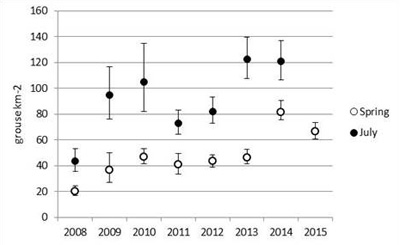
Which is more attractive: the chick or the egg? MSc student Kathryn Fingland, who studied red grouse nesting success at Langholm in 2014, has published her observations on a red grouse clutch desertion. Reproduced here with permission of British Birds. Read more. Spring 2015 red grouse counts complete Hen harriers, buzzards and 2015 research An update on harrier wintering and tagging, buzzard research and the summer 2015 fieldwork programme at Langholm Moor. Further information can be found on the news page. Black grouse on the increase Black grouse are increasing at Langholm in number but more importantly in range. Black grouse are regularly seen on areas that have treated with glyphosate, chopped and re-seeded with heather. One of these areas has a power line running through it, which has sadly resulted in the death of two greyhens and two black cock from hitting the power lines. The good news is that Sottish Power have fitted reflectors along the worst stretch of cable and the black grouse are still present. We’d like to thank Scottish Power for their help with this. Fewer red grouse this spring on Langholm Moor According to the project’s science team the number of red grouse on the Langholm Moor Demonstration Project site is less than at this time last year, despite best practice moorland management and typical weather between summer 2014 and spring 2015 (Figure 1).
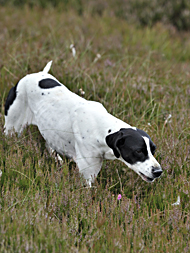
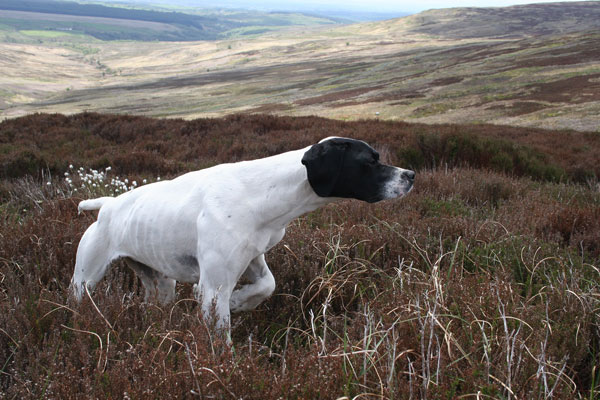
The spring weather allowed the project scientist Dr Sonja Ludwig and her pointing dog to complete these counts of the red grouse in three weeks this year. The counts were on the same areas as have been checked since the start of the project and involve walking across 68 km of the moor. The counts suggest there are between 60 and 73 grouse per 100ha of moor in spring 2015. This number is significantly less than spring 2014 (75-96 per 100ha).
The control of crows, foxes and parasites, improvement in habitat and a summer of good weather in 2014 suggested the numbers of grouse surviving to spring 2015 could have been at least as good as the previous year. But overwinter losses of 46% left fewer birds compared to spring 2014. As in past years, many of these losses are associated with raptor predation; 13 of 16 radio-tagged grouse found dead overwinter appear to have been taken by birds of prey. These grouse population figures reflect and confirm the findings of the project that were described in the 7-year review (here). They reinforce the position of the project board that it has to consider what actions are necessary for the project to achieve economically viable driven red grouse shooting, a key incentive in continuing to deliver successful habitat and raptor conservation on the moor.
Hen harriers wintering with us on the moor Last summer’s 10 nesting hen harriers produced 47 chicks, the highest level of nesting and chick production since the project began in 2008. We also have another record in that at least 10 birds are wintering on the moor, more than any winter to date. We are gearing up for the coming breeding season and keen to see how many birds nest with us in 2015.
LMDP’s buzzard study on schedule to finish on time
Summer 2015 fieldwork programme approved
This is on top of all the usual monitoring programmes that survey red grouse, vegetation, waders, small birds, voles and all other raptors. The large reliance on cameras and radios does have budget implications so these plans for now are subject to Board approval.
Our four satellite-tagged hen harriers – an update As of mid-January, two of our hen harrier chicks fitted with satellite tags in 2013 (which have both bred in 2014) are still with us on Langholm Moor; the third is in the Republic of Ireland. A fourth bird tagged in 2014 is still active near Moffat.
Black grouse on the increase
Seven Year Project Review launched The LMDP Directors have today launched the next staged review of project progress. Originally intended to summarise data to 2013, the report was produced allowing 2014 data to be included. Mark Oddy, current Chairman of the Project Board, says: “We are delighted to produce our most substantive report on the project yet. The Review shows that the project has met its targets for habitat improvement and the SPA target for harriers, which is good news. However, as yet red grouse populations have not recovered sufficiently to allow any grouse shooting. This means that we have not yet achieved the desired compatibility between the economic driver of red grouse shooting and raptor conservation. All the project partners will be looking at the opportunities there are to address this challenge in an Options Paper due to be published in the New Year.” The project review can be downloaded here.
Simon Lester tells it like it is in Radio 4 interview Simon Lester was a key contributor to the half hour programme ‘Hen Harriers: Trust in Conservation’, part of BBC Radio 4’s ‘Shared Planet’ series. You can listen again through the Radio 4 website to this episode about Hen Harriers and wildlife conflict.
2014 Raptor Monitoring Report The 2014 report on which and how many breeding raptors there were at Langholm this year is available here.
2014 Grouse Shooting Season There will be no grouse shooting on Langholm Moor this year. The recommendation of the Head Gamekeeper and the project's Scientific Contact Group is that we should not shoot in order to protect the breeding population of red grouse in 2015.The Directors accept these recommendations and confirm there will be no shooting in this the seventh year of the Project. The July 2014 grouse abundance derived from distance sampling methods indicated there were an average 127 birds/100ha. The 2014 counts indicate this was a modest breeding season with a 1.9:1.0 young to old ratio. The project target is to shoot 1000 brace of driven grouse in a season. The project plan estimated that at least 150 birds/100ha would be needed to achieve that goal. The best available evidence suggests that even in the absence of shooting this year, typical overwinter mortality will make progress towards this target very difficult next year. This is a disappointing result as the spring 2014 grouse counts were encouraging. Even assuming a poor breeding season our spring estimates of possible July densities were better than what was eventually counted. The project is analysing in detail the reasons for the poor grouse performance; habitat, weather conditions and losses to predation are being studied carefully. A complete analysis of the data will be available to Directors in September. Notes: 1. Further details on the summer grouse counts can be found here. 2. The project plan identified 1000 brace of driven grouse as a milestone target for shooting. This would not be sufficient to break even, but would demonstrate a recovery path to a position which could be considered financially sustainable.
Licenced raven control by Langholm Farms Ltd
SNH have granted a licence to Langholm Farms Ltd for the
limited control of ravens based upon evidence of serious damage to
lambing
sheep. The Langholm Farms Ltd operation includes the area occupied by
the
Langholm Moor Demonstration Project (LMDP). The LMDP has no involvement
with
the licence granted, nor its operation. 1. Ravens have caused serious damage
to agriculture across
Scotland for many years, notably to new-born lambs and lambing ewes. In
2013,
73 raven control licences were issued across Scotland by SNH to reduce
impacts
on lambing sheep.
2. In recent years Langholm Farms Ltd
(a subsidiary of
Buccleuch Estates Ltd) sheep have been seriously affected by raven
activity. The licence will allow Langholm Farms Ltd to take
a
limited number of ravens causing such issues, during the critical
lambing
period, as an aid to scaring.
3. Licences such as this are only
issued when SNH and
Scottish Government are satisfied that there are no other satisfactory
solutions.
Further information:
Older stories can be found in the News Archive. |
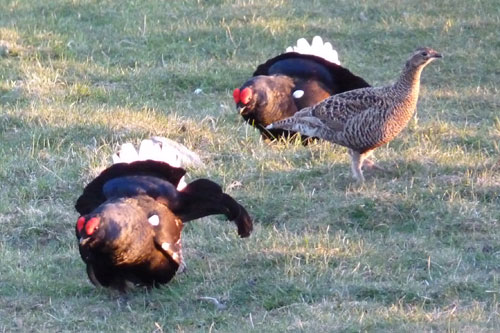 Many birds seemed to have been delayed by the recent spell of cold and wet weather, but the first harrier chicks have also hatched in the last week. There are currently five active nests but we’re expecting more to come. Neither did the dreich slow start to the year dissuade the black grouse from lekking. During the April and May counts, we saw an increase from 18 males on leks in 2014 to 29 males in 2015.
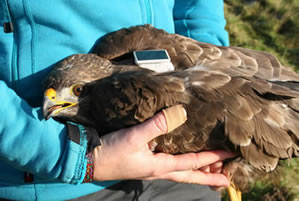 Our three-year PhD study on the feeding ecology of buzzards on Langholm Moor is on schedule to complete by May 2014. By then we hope the PhD thesis, written by Richard Francksen and supervised by Dr Mark Whittingham at Newcastle University and Dr David Baines of the GWCT, will be submitted and successfully defended. If this is achieved the PhD will have been completed in just over three years, a considerable success. Up to five scientific papers are planned from the work to be written up in the remainder of 2015.
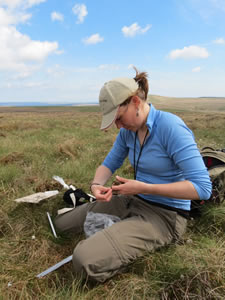 The Project’s internal scientific steering committee, the Science Contact Group (SCG) met in January to discuss and approve the summer 2015 fieldwork programme. This included:
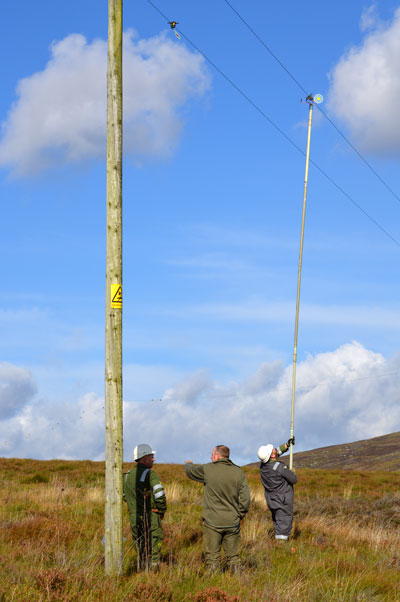 Black grouse are increasing at Langholm in number but more importantly in range. Black grouse are regularly seen on areas that have treated with glyphosate, chopped and re-seeded with heather. One of these areas has a power line running through it, which has sadly resulted in the death of two greyhens and two black cock from hitting the power lines. The good news is that Scottish Power have fitted reflectors along the worst stretch of cable and the black grouse are still present. We’d like to thank Scottish Power for their help with this.