| HOME |
| PROJECT DETAILS |
| PROJECT ADMINSTRATION |
| JOINT RAPTOR STUDY |
| THE MOOR |
| THE GROUSE |
| THE RAPTORS |
| OTHER WILDLIFE |
| DIVERSIONARY FEEDING |
| GAMEKEEPING |
| WILDLIFE SURVEYS |
| NEWS |
| CONTACT |
| PHOTO GALLERY |
Previous Diaries
| Simon Lester's gamekeeping diary |
Early Summer 2012 OUR fifth breeding season is now over. The majority of animals have now left their homes and are beginning to explore their new world. What a start they have had in this: the wettest summer on record. Most of the raptors have survived well. Some buzzards did not hatch all their eggs, but all 15 nests have produced young. This year, we’ve also been home to three merlin, two short-eared owl, four raven and two peregrine nests. And, eventually, a very late pair of hen harriers has produced four chicks, although it will be a while until they fledge. Diversionary food is being taken and the nest watches are about to start.
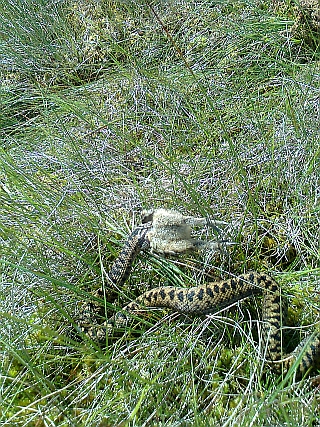
Everyone say "Awww..." We now have a PhD student studying the buzzards and have had a Masters student monitoring them during the nesting period. After four years’ hard work, Damian Bubb, our head scientist, has left his post, which has meant all hands to the pump to continue with all the monitoring. A new head scientist has been appointed and she will start work in September. In the meantime, Dave Baines and Aly McCluskie have bridged the gap. Sadly, at the end of July, we also say goodbye to Aly and his partner, Paula Keane. As RSPB staff they have monitored the harriers since the start of the Project and have carried out a lot of the fieldwork as well. Monitoring still goes on and the rain has helped the heather to grow and the moor is covered with acres of new heather. It’s looking healthy and, so far, there are no great signs of heather beetle; they don’t like hatching in wet weather either. This year the moor should look purple when the heather flowers. We have not been able to get on and do this year’s round of Glyphosate spraying or to spray the three-year-old sites with Graminicide. There is a lot of wavy hair grass coming through on some sites, which is not as serious a problem as the Molinia, but it needs to be checked to allow the heather and other plants to thrive. Cotton grass, bog rosemary, sundews and heather are all doing well on the sprayed patches, which is liberally strewn with purple spotted orchids. These patches have also produced the best crop of waders we’ve had, still very small number compared with one amazing moor I visited this summer, a sight and a sound I could only wish for. With the sheep off nearly all the grouse ground, many flowers have thrived, assisted by the weather; foxgloves, in particular, have been spectacular, with lots with multiple stems of flowers. The bracken has been slow in growing this year because of the late spring. Last year we had a harrier nest in the bracken. This year, if the birds had tried to nest in the same place, the nest would not have been hidden, although the bracken’s caught up now. The bracken spraying that was done last year looks to be very successful. Predation of grouse chicks is an on-going concern. But, of all the creatures that I’ve seen and know take chicks, I could not begrudge the adder that gobbled one up and, in doing so, provided me one of the very special wildlife moments (well, it was more like half an hour actually). One day when I was out doing my rounds, I could hardly believe my eyes when, on the bike track in front of me, I saw an adder with a grouse chick’s head in its mouth. Looking at the size of the chick—which looked about four days old, with its wing feathers just forming—and the size of the adder’s head, I thought: “You’ve bitten off more than you can chew, old sport.”
I just had to watch as, with a lot of huffing and puffing and backward motion, the chick slowly disappeared bit by bit until, eventually, only its white feathery feet protruded from the fully distended mouth of this stretched and distorted viper. |