| HOME |
| PROJECT DETAILS |
| PROJECT ADMINSTRATION |
| PUBLICATIONS |
| JOINT RAPTOR STUDY |
| THE MOOR |
| THE GROUSE |
| THE RAPTORS |
| OTHER WILDLIFE |
| DIVERSIONARY FEEDING |
| GAMEKEEPING |
| WILDLIFE SURVEYS |
| NEWS |
| CONTACT |
| PHOTO GALLERY |
| THE GROUSE |
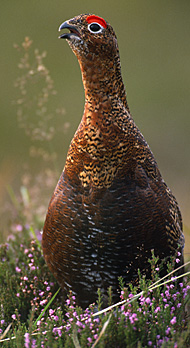
*Updates on the post-project red grouse counts will be posted on the website’s landing page* The red grouse is one of Britain's most iconic species. The look and culture of many of our upland landscapes has been shaped by our association with this quarry species which recent genetic studies suggest may be endemic, unique to the British Isles. A short video of a red grouse brood at Langholm moor can be seen here (with thanks to Making the Most of Moorlands). In the early part of the 20th century, Langholm Moor was one of the most productive moors for red grouse in Britain. Data published in the Joint Raptor Study showed there was a long-term decline in the number of grouse shot at Langholm from 1948 onwards. This was not due to raptors but most likely caused by the 48% reduction in the extent of heather cover. In common with other nearby moors grouse numbers cycled every 6-7 years due to recurrence of the parasitic worm Trichostrongylus. During and immediately following the Joint Raptor Study densities of red grouse failed to recover from a cyclic low and continued to decline. This was caused by predation from birds of prey. Between 1999 and 2008 Langholm was not run as a driven grouse moor.
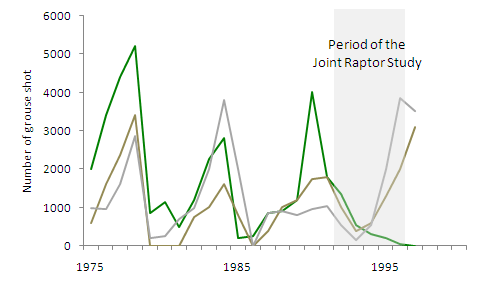
Numbers of grouse shot at Langholm (green) since 1975 compared to two nearby moors (grey and brown). All three shown cyclic changes in number due to the periodic parasitic disease Strongylosis, but unlike the other two, Langholm failed to recover after the hen harriers became established during the Joint Raptor Study. The LMDP project sought to produce a population of red grouse sufficient to sustain an economically viable driven grouse shoot. A target of 1,000 brace of grouse shot in one year was set. This would not be sufficient to break-even but would demonstrate a recovery path to a position which could be considered financially sustainable. Grouse counts Red grouse are counted across the moor twice a year. Transects counts are used to survey 8 to 10 plots of 50ha as well as another 35 kilometres of transect lines. The grouse are found using pointing dogs. The actual number of grouse found on the block counts are used to maintain trends back to the Joint Raptor Study. The number of grouse found on all of the transects are run through a statistical process called 'Distance Sampling'. Distance Sampling is a technique to estimate population density, which can account for the area effectively searched by the dog, and thus correct for differences between individual dogs and observers. These data are used to describe how the population is performing. For example, we can calculate that between summer 2016 and summer 2017 annual adult red grouse breeding survival (based on distance sampling estimates) was 53% (95% confidence interval 39-73%).
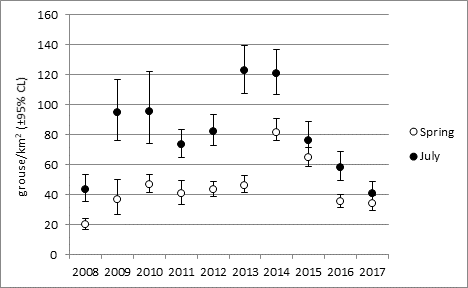
Average spring and summer red grouse density (numbers per 100ha = 1km2) on the survey transects at Langholm since the start of monitoring in spring 2008. Densities are calculated using Distance Sampling methods and vertical lines represent 95% confidence intervals. *Updates on the post-project red grouse counts will be posted on the website’s landing page*
|
|